





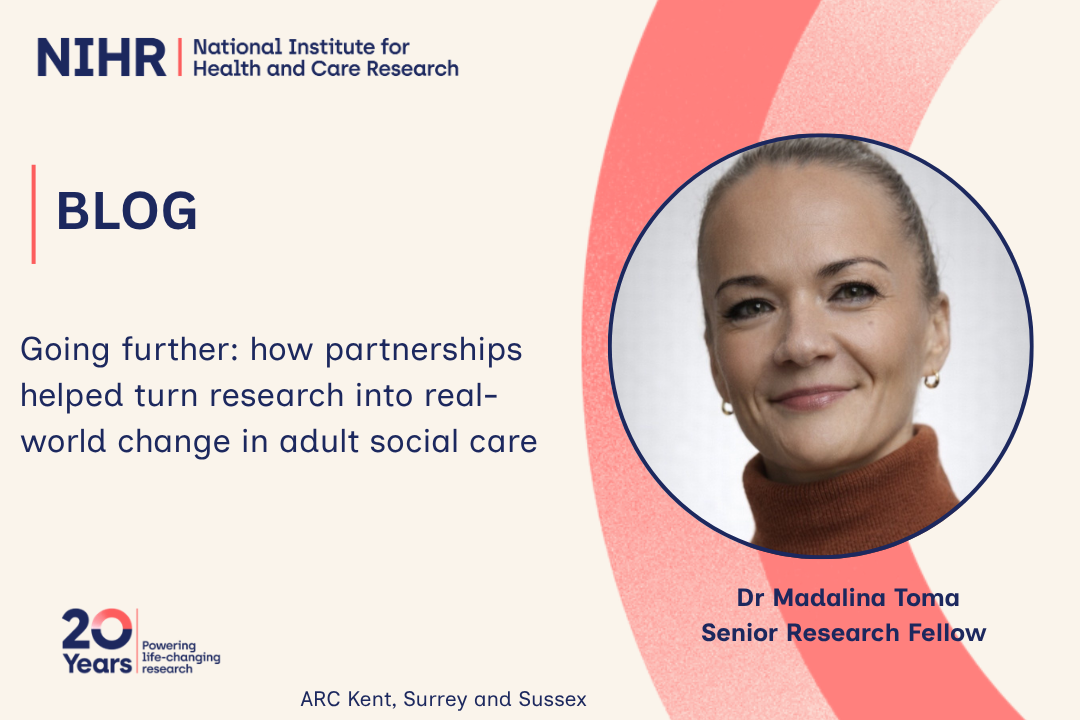
By Dr Madalina Toma, Senior Research Fellow
NIHR Applied Research Collaboration (ARC) Kent Surrey Sussex and Centre for Health Services Studies (CHSS), University of Kent
Over the past 5 years, I’ve had the privilege of working as coordinating researcher for the National Priority Programme for Adult Social Care and Social Work, led by the Applied Research Collaboration Kent, Surrey and Sussex (ARC KSS). Looking back, what stays with me most is the strength of the partnerships behind the work. This was a £2.5 million National Institute for Health and Care Research-funded programme bringing together 9 Applied Research Collaborations and 11 universities, alongside practitioners, charities, local authorities and people with lived experience, all working towards one shared goal: making research more useful in everyday adult social care and social work.
Across 6 core projects and 5 seed-funded studies, we explored issues that matter deeply to people and services: care planning and wellbeing in care homes, digital inclusion and social wellbeing, whole-family approaches for families affected by domestic abuse, community signposting, community-led support, and lived experience in research. Each project tackled a different challenge, but they all came back to the same question: how do we move beyond good ideas and make change happen in real-world systems? That is where implementation matters. Throughout the programme, we focused not just on generating evidence, but on understanding what works, for whom, in what contexts, and how learning can be adopted, adapted and sustained in practice.
One of the most rewarding parts of this role was seeing what can happen when people work across boundaries. The programme connected researchers, practitioners and communities across England, as well as building a strong lived experience infrastructure, including a Strategic Lived Experience Group of 15 public contributors, 7 project-specific advisory groups and people with lived experience working as co-researchers. In total, public contributors alone gave more than 720 hours to shaping the programme. That input was not an add-on. It helped ensure the research stayed grounded in the realities of people’s lives and the pressures facing services.
I’m especially proud that the programme has produced more than academic papers. Alongside 41 published and disseminated outputs and 19 conference talks and presentations, teams won European research awards and created practical resources, toolkits and accessible materials designed to be used in real settings. There were 26 engagement activities, 4 national gatherings and 9 creative, accessible outputs to help share learning more widely. That matters, because success is not just about generating evidence. It is about whether that evidence is understood, shared and used to improve support for people and communities.
As we move into our next 5 years of funding at the ARC KSS, this work gives us a strong foundation for what comes next. This collaborative national programme has shown that when partnerships are built on trust, shared purpose and a clear focus on implementation, research can travel further and have greater impact. It has helped create a stronger national platform for adult social care and social work research, practical learning for services, and a connected community that can keep building on this momentum. For me, that is the real legacy of the programme: not only the evidence produced, but the relationships, confidence and shared commitment that will help turn research into meaningful, lasting change.
